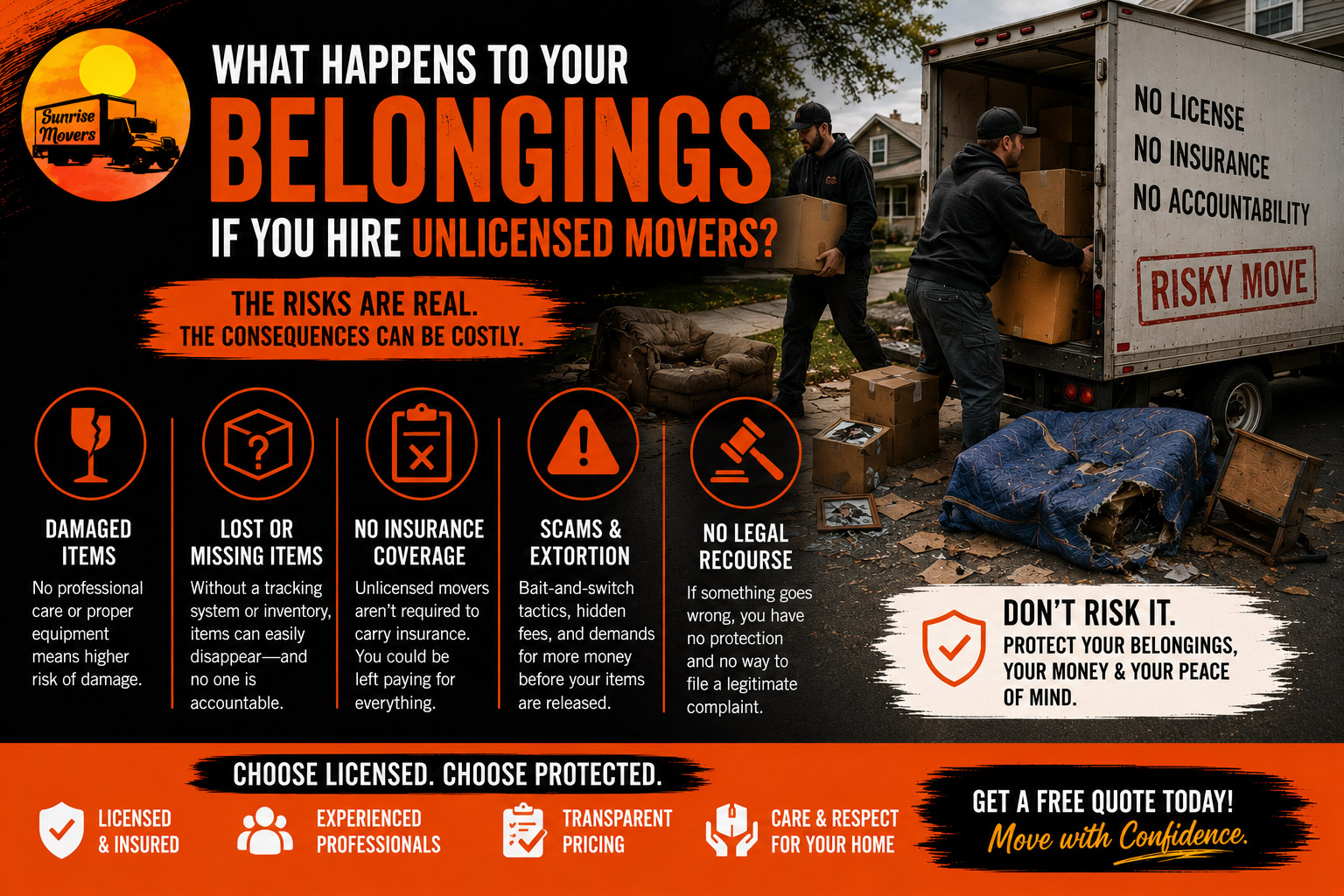
What Happens to Your Belongings If You Hire Unlicensed Movers?
The Risk Nobody Mentions When You're Comparing Moving Quotes
When one moving quote comes in dramatically lower than every other one you've received, it's worth pausing before you celebrate. A lower price sometimes reflects a smaller company with lower overhead. But it can also signal something more concerning: a company operating without a license, without insurance, or without any real accountability if something goes wrong.
Unlicensed movers are more common than most people realize, especially in markets where moving demand is high and customers are primarily comparing prices. In Gravois Mills, MO and throughout the Lake of the Ozarks region, the consequences of hiring one can range from minor frustration to a complete financial loss. Here's what you need to know before you hand anyone the keys to your home.
What Licensing Actually Means for a Moving Company
Licensing isn't a formality — it's the mechanism that makes moving companies financially and legally accountable. In Missouri, movers operating within the state must register with the Missouri Department of Transportation. Companies that cross state lines must hold a USDOT number issued by the Federal Motor Carrier Safety Administration. These registrations require companies to carry minimum insurance coverage, maintain safety standards, and be identifiable if something goes wrong.
When a company skips licensing, they're skipping the accountability that comes with it. They may have no verifiable insurance. They may have no physical business address. And if your belongings are damaged, stolen, or held hostage, you may have very limited legal recourse against a company that doesn't officially exist.
What Can Go Wrong When You Hire an Unlicensed Mover
The risks run the full spectrum from inconvenient to catastrophic. These are the most common scenarios customers have experienced with unlicensed operators.
No insurance coverage: If items are damaged or destroyed, there is no liability policy to file a claim against — the loss is yours entirely
Theft: Unlicensed movers have no license to lose and no bond to forfeit, which removes a significant deterrent against theft of your valuables
A hostage load: Your belongings are loaded onto the truck and then held until you pay a dramatically inflated price — a tactic with very limited legal recourse when no contract exists
No-shows: Informal operations with no business infrastructure may simply fail to appear on moving day, leaving you scrambling
Injury liability: Workers without proper workers' compensation coverage who are injured on your property may have grounds to hold you liable for their medical costs
No recourse after the fact: Without a registered business address, a USDOT number, or a verifiable identity, tracking down an unlicensed company after a problem is often impossible
The Hostage Load: How This Tactic Actually Works
The hostage load is one of the most alarming tactics used by rogue moving operations, and it follows a disturbingly consistent pattern. Understanding the sequence helps you recognize the warning signs before it's too late.
You receive a quote that is significantly lower than other estimates, typically given over the phone without an in-home assessment
The movers arrive, load all of your belongings onto the truck, and drive to your new address
At delivery, they present a final bill that is dramatically higher than the original quote, citing vague additional charges or reinterpreted pricing
When you question or refuse the inflated bill, they refuse to unload your belongings until you pay in full
Without a written contract, a licensed registration to report, or a real business identity to hold accountable, your options are severely limited
This is not an isolated or rare scenario. It has been reported in Missouri and across the country, including in smaller regional markets like Lake of the Ozarks, Missouri. The customer's only real protection is choosing a licensed, insured company before the truck is ever loaded.
How to Verify a Moving Company Before You Book
Taking a few minutes to verify a company's credentials before committing can protect you from serious financial harm. Here is the exact process to follow.
For interstate moves, search the company's USDOT number at safer.fmcsa.dot.gov to confirm active registration, insurance status, and any safety violations on record
For intrastate Missouri moves, contact the Missouri Department of Transportation to confirm the company is properly registered to operate in the state
Search for the company's physical address and confirm it corresponds to a real, verifiable business location — not just a phone number or website
Check reviews on established platforms like Google and the Better Business Bureau, paying attention to how long the company has been in business and how complaints are handled
Request a copy of the company's certificate of insurance before your move date and verify it is current
Get a written, itemized quote and a signed contract before agreeing to anything — then read both carefully
Red Flags to Watch for When Getting Moving Quotes
Certain patterns in how a company presents itself and its pricing should give you pause. Watch for any of the following.
Price significantly below every other quote: A gap this large rarely reflects legitimate efficiency — it usually reflects missing costs like insurance, licensing, or proper wages
Quote given without seeing your items: Any accurate estimate requires knowing what you're moving — a phone quote based on a room count alone is a sign the mover isn't being thorough or transparent
Payment demanded in cash upfront: Legitimate movers collect payment at delivery, not before loading — full upfront cash payment removes your leverage entirely
No physical business address: A company that exists only as a phone number or Facebook listing has no accountability if something goes wrong
Unprofessional or generic branding: Unmarked rental trucks, generic company names, no uniforms — these details matter because they often indicate an informal operation with no vested interest in its reputation
Pressure to book immediately: Legitimate companies don't need to pressure you into fast decisions — urgency tactics are often used to prevent you from doing basic verification
Frequently Asked Questions
Does homeowner's or renter's insurance cover losses caused by an unlicensed mover?
Some policies include off-premises personal property coverage that may apply, but limits are often low and deductibles can be significant. Proving the loss occurred under specific circumstances involving an unlicensed operator can also complicate the claims process. Do not treat your homeowner's insurance as a safety net for mover negligence — it was not designed for that purpose.
What exactly is a "rogue mover" and how do I identify one?
A rogue mover is an individual or company operating without proper licensing, insurance, or legitimate business practices. The defining characteristic is the absence of accountability. Red flags include phone quotes without in-home assessments, no written contract, cash-only payment requirements, no verifiable business address, and prices that are dramatically lower than every other quote you've received.
Can I report an unlicensed mover to authorities?
Yes. For interstate moves, file a complaint with the FMCSA's National Consumer Complaint Database online. For intrastate moves in Missouri, contact the Missouri Attorney General's Consumer Protection Division. Filing a report creates a record that can alert future customers and, in some cases, triggers investigation of the operator.
Are movers found through social media or classified listing sites less trustworthy?
Not inherently — but they require more scrutiny because informal channels have fewer barriers to entry for unlicensed operators. Apply the same verification steps to any mover you find online: check their USDOT number or state registration, confirm their physical address, read their reviews, and request proof of insurance before booking.
How do I find licensed movers serving the Lake of the Ozarks area?
Start with referrals from neighbors, real estate agents, or local businesses who have moved recently in Lake of the Ozarks, Missouri. Search Google for movers with established review histories in the region. Then verify each company's credentials directly through the FMCSA or the Missouri DOT before making any commitments. A small amount of upfront research is far less costly than the alternative.
Conclusion
The risk of hiring an unlicensed mover is not hypothetical — it plays out in damaged belongings, stolen property, financial extortion, and complete loss of recourse. Choosing a licensed, insured moving company isn't an upsell. It's the minimum protection your household deserves. In Gravois Mills, MO and across the Lake of the Ozarks region, Sunrise Movers operates as a fully licensed and insured moving company committed to transparent service and professional accountability on every job. Don't leave your belongings in unknown hands — contact Sunrise Movers today for a trustworthy moving experience you can count on.
